Whether you’re fitting out a new apartment in Downtown Dubai, renovating a villa in Arabian Ranches, or upgrading a home in Dubai Hills Estate, one question comes up in almost every kitchen project: should you go with modular kitchen cabinets or invest in custom joinery?
It’s not a simple answer. Both options have a place in Dubai’s interior fitout market — and the right choice depends on your budget, timeline, space, and long-term goals. This guide breaks down every angle so you can make the smartest decision for your home.
Understanding the Difference: Cabinets vs Custom Joinery
Before comparing the two, it’s worth being clear on what each actually means in the context of a Dubai fitout.
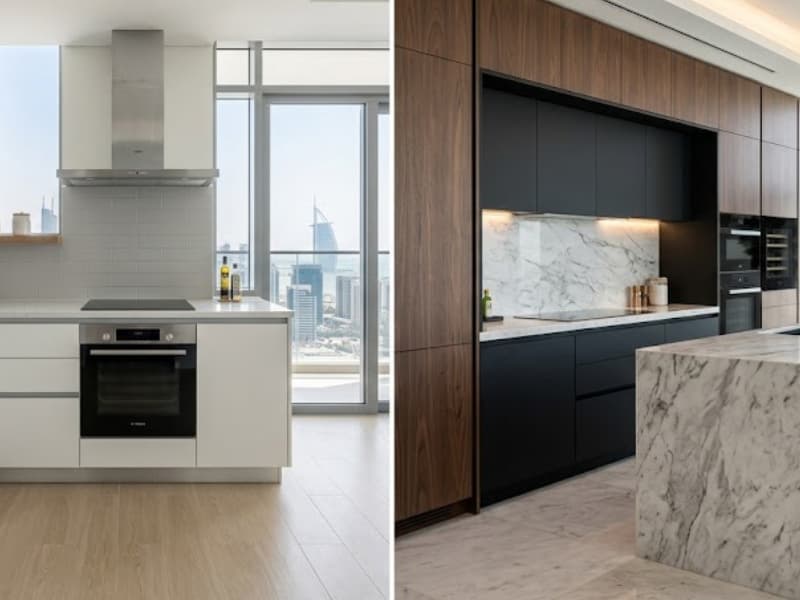
Modular kitchen cabinets are pre-manufactured units — typically produced in standard dimensions and available through suppliers, showrooms, or imported brands. You choose from a set range of finishes, sizes, and configurations, and a team assembles them on-site. Popular brands serving Dubai include German manufacturers like Häfele and Blum-fitted ranges, as well as Italian imports and mid-range options produced in UAE workshops.
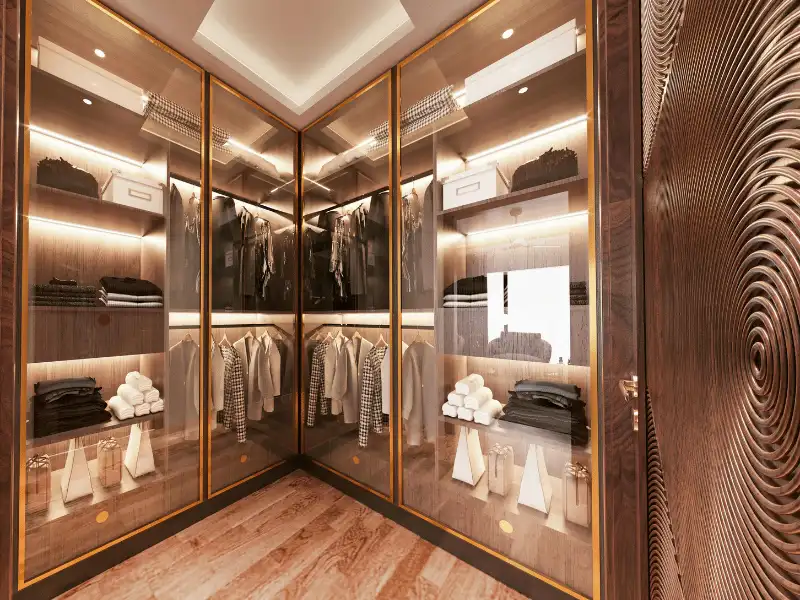
Custom joinery, on the other hand, is designed and fabricated from scratch specifically for your space. A joiner or fitout contractor measures your kitchen, designs around your exact layout and lifestyle, and builds every cabinet, shelf, island, and pantry unit to your precise specifications — materials, dimensions, hardware, and finish included.
Both involve cabinetry. Both can look stunning. The difference lies in flexibility, cost, process, and outcome.
Cost Comparison: What Are You Actually Paying in Dubai?
Let’s talk numbers, because this is usually the first question Dubai homeowners ask.
Modular kitchen cabinets in Dubai typically start around AED 1,500–2,200 per linear metre for mid-range options. Premium imported ranges can climb to AED 3,500–4,500 per linear metre, depending on finish and hardware quality.
Custom joinery sits at a different price point. According to interior fitout professionals, custom kitchen joinery costs 20–30% more than ready-made alternatives on average — but the gap narrows significantly when you factor in what you get in return. A fully bespoke kitchen from a reputable Dubai joinery company typically ranges from AED 2,200 to AED 6,500 per linear metre, with luxury finishes, marble worktops, and integrated appliances pushing budgets higher.
However, a direct price comparison can be misleading. Modular cabinets often require additional carpentry work to fill gaps, adapt to non-standard walls, or accommodate Dubai apartment quirks like off-angle corners, built-in AC ducts, or awkward column placements. Those workarounds add cost. With custom joinery, none of that is an afterthought — it’s designed in from day one.
Pro tip: If you’re ordering kitchen joinery alongside wardrobes and a TV unit, bundling everything with the same manufacturer typically saves 15–20% through production efficiency and shared delivery costs.
Design Flexibility: Where Custom Joinery Wins Outright
This is where the difference becomes most visible. Dubai homes — particularly apartments in towers like those in Business Bay, JLT, or Palm Jumeirah — rarely have standard-shaped kitchens. Irregular layouts, exposed columns, angular walls, and tight galley configurations are extremely common.
Modular cabinets are built around standard measurements. That means compromises: awkward gaps, wasted corners, filler panels that look like afterthoughts, and storage that doesn’t quite work for how you actually cook. For a straightforward rectangular kitchen with typical ceiling height, modular can work well enough. But the moment your kitchen deviates from the norm — which in Dubai, it usually does — the limitations become apparent.
Custom joinery eliminates those limitations entirely. A joiner takes your room’s exact dimensions from the very start of the project. An awkward L-shaped kitchen becomes an opportunity rather than a problem. One case study from a Dubai apartment fitout showed that custom joinery in an irregular kitchen layout delivered 40% more storage capacity compared to what modular units could have achieved — plus a breakfast bar and island that simply wouldn’t have been possible otherwise.
For homeowners looking to achieve specific interior design styles — whether that’s a sleek minimalist look with handleless cabinets and integrated appliances, a warm Japandi aesthetic with fluted wood panels, or a high-gloss contemporary finish — custom joinery gives you total control over every design detail.
Quality and Longevity: A Long-Term Investment Perspective
Dubai’s climate adds a dimension that many homeowners don’t consider until it’s too late: humidity, temperature swings between air-conditioned interiors and outdoor heat, and the dust common to desert environments all affect joinery performance over time.
Modular cabinets, particularly at mid-price points, often use MDF board with a melamine or foil wrap. These materials are serviceable but can be vulnerable to moisture damage near sinks, swelling at joints over time, or delaminating in kitchens with poor ventilation. Edge banding can lift. Hinges on budget units wear faster.
Moisture-resistant materials should be specified explicitly in any Dubai kitchen project — a requirement that’s easier to enforce and verify when you’re commissioning custom work than when choosing from a pre-set product range.
Custom joinery, when done by a reputable fitout contractor in Dubai, typically uses higher-grade materials throughout — moisture-resistant MFC or marine-grade MDF, solid timber accents, and premium hardware from brands like Blum, Hettich, or Häfele. These components are engineered for daily use and genuinely last. A well-made piece of bespoke joinery will outlast a generic store-bought unit by many years and stay in your home as long as you own it.
This matters enormously in Dubai’s property market. Homes with high-quality custom joinery command stronger resale and rental appeal. Whether you’re in a luxury villa in Emirates Hills or a premium apartment in Downtown, quality finishes are one of the first things buyers and tenants notice.
Timeline: When Speed Matters
Here’s where modular cabinets genuinely have an edge.
If you’re in a hurry — fitting out a rental unit, flipping a property, or working around a tight move-in date — modular kitchen cabinets can be procured and installed significantly faster. Standard modular units can often be delivered and installed within two to four weeks of order.
Custom joinery takes longer. The process involves a site survey, design consultation, material sourcing, workshop fabrication, quality checks, and installation. Depending on complexity and the contractor’s current workload, you’re typically looking at four to eight weeks, sometimes longer for high-end or large-scale projects.
For homeowners who are planning ahead — as most Dubai villa and apartment fitout projects allow for — this timeline is entirely manageable. For urgent turnarounds, modular may be the pragmatic choice.
Space Optimisation: The Hidden Advantage of Bespoke
One of the most underappreciated benefits of custom joinery in Dubai homes is the ability to maximise every square centimetre of available space. Dubai apartments, particularly in mid-rise and high-rise towers, tend to have compact kitchens relative to their overall footprint. Every bit of storage and worktop space counts.
Custom joinery addresses this by designing around the room from first principles — not forcing a room to accommodate pre-made units. Floor-to-ceiling cabinetry can be made exactly the right height. Corner units can incorporate pull-out systems or Lazy Susans that genuinely work. Pantry columns can be built into wall recesses. Islands can be sized precisely for the space available rather than chosen from a catalogue.
For Dubai homes where entertaining and cooking are important parts of daily life, this spatial intelligence transforms how a kitchen actually functions — not just how it looks.
Materials and Finishes: 2025–2026 Trends in Dubai
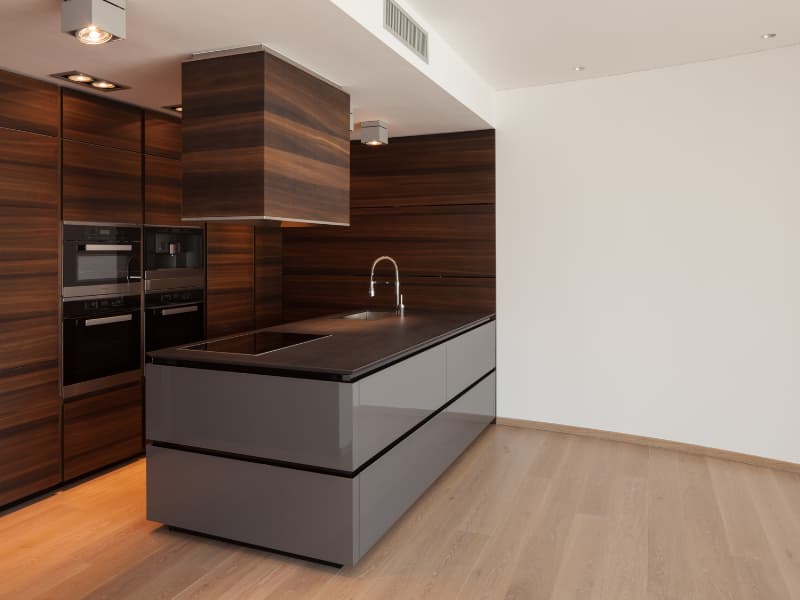
The most requested kitchen finish for Dubai homes in 2025–2026 is matt lacquer in white, grey, and greige tones. These finishes photograph well, hide minor surface marks, and align with the modern minimalist aesthetic popular across Downtown, Business Bay, and Dubai Hills Estate properties. Both modular and custom joinery can achieve this look, but custom work gives you far more precise control over the exact shade, sheen level, and texture.
Other trending directions include:
- Fluted wood accents on island fronts and cabinet panels — a hallmark of high-end custom joinery work
- Integrated appliances with flush panel fronts, virtually impossible to achieve cleanly with standard modular units
- Handleless push-to-open systems using Blum or Salice mechanisms
- Sintered stone and quartz worktops (Silestone, Caesarstone) for durability and heat resistance
- Two-tone kitchens with contrasting upper and lower cabinet finishes
Most of these looks require custom joinery to execute properly. Modular systems offer some of them as options, but the integration tends to be less seamless and the material quality less consistent.
Which Should You Choose? A Quick Decision Framework
There is no universal right answer — but here’s a practical framework for Dubai homeowners:
Choose modular kitchen cabinets if:
- Your kitchen is a standard rectangular layout with typical ceiling heights
- You have a tight timeline (move-in within 3–4 weeks)
- Your budget is limited and you’re fitting out a rental or investment property
- You’re happy with the available finishes and standard configurations
Choose custom joinery if:
- Your kitchen has an irregular layout, columns, or non-standard dimensions
- You want total control over materials, finishes, and hardware
- You’re investing in a long-term home or a property you want to sell or rent at a premium
- You want integrated appliances, bespoke storage solutions, or a cohesive look that carries through your entire home
- Sustainability and material quality matter to you
For most owner-occupied homes in Dubai — particularly villas, townhouses, and premium apartments — custom joinery is the more intelligent long-term investment. The upfront cost differential is real, but the gap in quality, longevity, design coherence, and property value is larger.
Working With a Dubai Fitout Contractor: What to Ask
Whether you choose modular or bespoke, your choice of contractor matters as much as the product itself. When briefing a kitchen fitout contractor in Dubai, always ask:
- Are materials moisture-resistant and suitable for UAE climate conditions?
- What hardware brands do you specify, and are Blum or Hettich systems available?
- Can I see examples of completed projects in similar-sized Dubai apartments or villas?
- What is the fabrication timeline and installation process?
- Do you offer post-installation warranty and snagging support?
- Can the kitchen joinery be bundled with wardrobes or other joinery for a cost saving?
Getting clear answers to these questions will help you distinguish between contractors who genuinely understand high-quality fitout work and those who are simply assembling off-the-shelf components.
Final Verdict
For Dubai homeowners who are serious about their interiors, custom joinery wins on almost every dimension that matters over the medium and long term: design flexibility, material quality, space efficiency, longevity, and property value. The higher upfront cost is real, but it reflects craftsmanship, precision, and a product that is genuinely built for your home — not adapted to it.
Modular kitchen cabinets have an important role to play — particularly for investment properties, rental units, and projects where budget or speed are the primary constraints. Used thoughtfully, with quality hardware and proper installation, they can deliver a strong result.
But if you’re building the kitchen you actually want to live in — one that fits your space perfectly, reflects your taste, and holds up beautifully for years in Dubai’s demanding climate — custom joinery is the investment worth making.