The open-plan living trend has dominated the Dubai real estate market for years. Whether you are moving into a contemporary villa in Dubai Hills or a high-rise apartment in Dubai Marina, the “great room” concept—where the kitchen, dining, and living areas flow into one—is the standard.
However, in our experience at Sierra Contracting, we’ve noticed a shift. Most clients come to us with a common dilemma: they love the light and the sense of space that open-plan layouts provide, but they are struggling with the lack of privacy. Sound travels, cooking smells drift into the lounge, and having a dedicated “work-from-home” corner feels impossible when you’re staring at the kitchen sink.
The instinct is often to build a wall. But in a city where natural light is a premium and space needs to feel airy, a solid partition can often make a beautiful room feel cramped and dark. This is why we usually recommend exploring creative room separation ideas that define zones without sacrificing the “open” feel of your home.
Why Open-Plan Layouts Need “Zoning”
In our years of renovating Dubai homes, we’ve seen that a completely open space often feels unfinished. Without clear boundaries, furniture can look like it’s “floating” in the middle of a hall.
We often see homeowners try to fix this by pushing all their furniture against the walls, which actually makes the room feel smaller. Instead, the goal should be to create “micro-zones.” You want a space that feels cohesive but serves different functions. Whether it’s shielding the entryway from the living room or creating a quiet nook for reading, finding the right partition solutions is about balance.
If you’re considering a larger overhaul of your space to fix these layout issues, you can learn more about how we approach home renovations to ensure your floor plan actually works for your lifestyle.

-
Slatted Timber Screens: The Dubai Favorite
If there is one design element we find ourselves recommending more than any other, it’s the timber slat partition. In a Dubai context, wood adds a much-needed organic warmth to the often cool, tiled floors of local villas.
Why it works:
- Light Permeability: You get the visual boundary of a wall, but sunlight still filters through.
- Architectural Interest: It looks like a design feature rather than a functional necessity.
- Privacy: If you angle the slats correctly, you can create a “one-way” privacy effect where you can see out, but guests in the hallway can’t see directly into your living space.
Our tip: We usually recommend matching the wood grain to your flooring or kitchen cabinetry to keep the palette consistent. However, be careful with the spacing. Too wide, and it doesn’t offer enough open-plan privacy; too narrow, and it starts to feel heavy.
-
Glass Partitions with Metal Framing
For those who lean toward a modern or industrial aesthetic, glass is the ultimate solution for room separation ideas. We frequently use Crittall-style (black-framed) glass doors or fixed panels to separate kitchens from dining areas.
The Tradeoff:
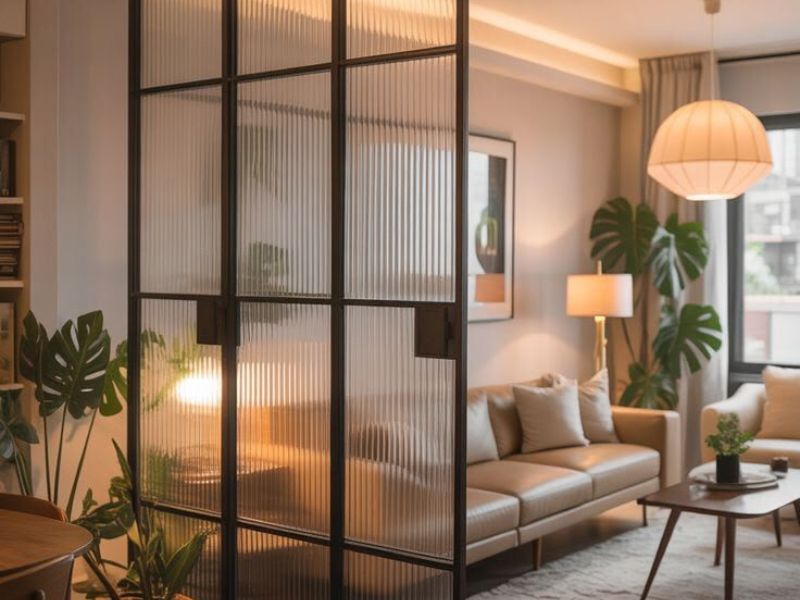
Glass is perfect for noise reduction—which is a huge concern for families with kids—but it doesn’t provide visual privacy. If your goal is to hide a messy kitchen after a dinner party, clear glass won’t help. In those cases, we often suggest fluted or frosted glass. It obscures the view while still letting every bit of light pass through.

-
Using Furniture as a Boundary
You don’t always need to “install” something to create separation. In many of our projects, we use the furniture itself to act as a soft divider.
Practical Furniture Strategies:
- The Console Table: Placing a long console table behind a floating sofa immediately signals the end of the “living zone” and the start of a walkway or dining area.
- Open Bookshelves: Double-sided shelving units are excellent partition solutions. They offer storage and a place for styling, and because they don’t have a back panel, they don’t block the view of the rest of the room.
- Sectional Sofas: An L-shaped sofa is a natural wall. We often see clients try to hide the back of the sofa, but in a large open space, letting the sofa back face the dining room is a great way to “box in” the lounge area.
-
Floor and Ceiling Transitions
This is a more subtle approach, but it’s incredibly effective. Sometimes, you don’t need a physical vertical barrier to create room dividers; you just need to change the “plane.”
In our experience, changing the flooring material—for example, transitioning from a wood-look porcelain tile in the living area to a marble finish in the dining room—creates a clear mental boundary. Similarly, a dropped ceiling or a specific lighting cove over the dining table can “anchor” that space, making it feel like its own room without a single wall in sight.

Common Mistakes Homeowners Make
When trying to solve privacy issues, we see a few recurring mistakes that can actually hurt the flow of a Dubai home:
- Over-cluttering with folding screens: While portable screens are cheap, they often look like an afterthought. In a high-end Dubai interior, they can make a space look messy rather than intentional.
- Ignoring the “Path of Travel”: We often see partitions placed in a way that forces people to walk in awkward zig-zags. Your room separation ideas should never interrupt the natural flow of movement through the house.
- Blocking A/C Vents: This is a big one in the UAE. Before installing a floor-to-ceiling partition, you must check the location of your AC registers. Blocking airflow in a 40°C summer is a mistake you’ll regret quickly.
-
Greenery and “Living Walls”
For a softer, more breathable feel, we often suggest using indoor plants as a natural partition. Large planters with tall species like Sansevieria or Fiddle Leaf Figs can create a lush, vibrant screen.
This works particularly well in villas with large floor-to-ceiling windows. It bridges the gap between the garden and the interior while providing a psychological sense of privacy. The only downside? Maintenance. If you aren’t prepared for the upkeep, high-quality artificial “green walls” are becoming a popular alternative in the Dubai market.
-
The Power of Curtains and Textures
Don’t underestimate the humble curtain. In many contemporary studio apartments or smaller villas, a ceiling-mounted track with heavy, floor-to-ceiling sheers can create a “flexible wall.”
This is an excellent solution for open-plan privacy in bedrooms or home offices. You can pull them shut when you’re working or sleeping and tuck them away when you want the full expanse of the room. It adds a level of softness and acoustic dampening that hard partitions simply can’t match.
Finding the Right Balance
At the end of the day, designing for privacy is about understanding how you actually live in your home. Do you need a total visual block, or just a way to dampen the sound of the TV? Do you want something permanent, or a solution that can change as your family grows?
At Sierra Contracting, we believe that the best homes are those that feel structured yet fluid. By using creative room dividers and thoughtful layout planning, you can have the best of both worlds: the beauty of an open-plan home and the sanctuary of a private space.
If you’re ready to rethink your layout and want a team that understands the unique challenges of Dubai interiors, we’re here to help you navigate those trade-offs and build a space that feels just right.